都一处档案 · The Duyichu Archive
档案The Vault · a record of the only place
卷 I · 1738 — 今Nearly three centuries leave a great deal behind — and almost none of it photographed. What survives of the only place is gathered here: reconstructed where the camera could not reach, and, for the century that could, awaiting the prints and papers still held in family drawers and municipal files.
乾隆三年 · 1738
A lamp at Xianyukou
都档 · 1738 · 001–002
A Shanxi man, Wang Ruifu, opens a plain wine shop in a lane by the Qianmen gate. No sign worth painting — only a broken gourd hung at the door, and a lamp kept lit later than its neighbours'. No image of that first year exists; this is drawn from the record.
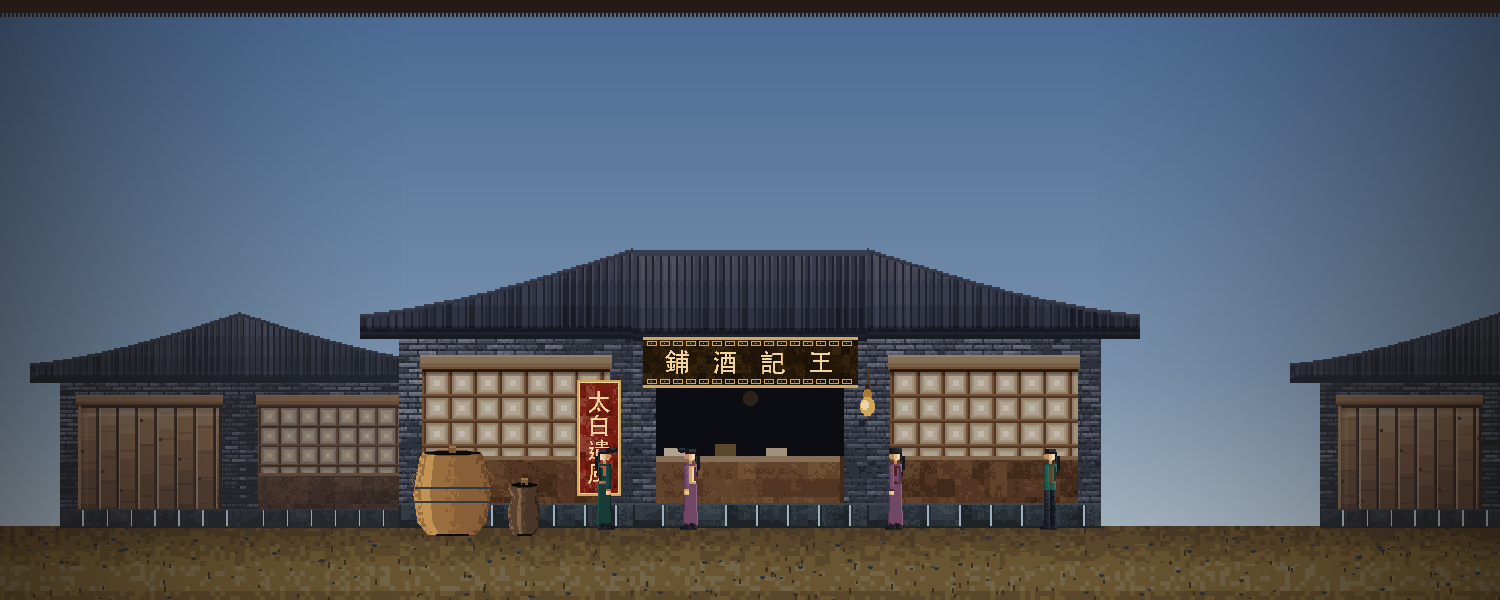
On the record
The founding is documented in the 老字号 registers and the Qing surveys of the Xianyukou lanes; the gourd sign (碎葫芦) is remembered in the shop's own lore. The scene is composed from those sources — a drawing standing in for a photograph that could never have been taken.
乾隆十七年 · 1752
The name from the palace
都档 · 1752 · 003–004
On a snowbound New Year's Eve, a traveller in plain clothes finds the one door still glowing and asks the shop its name. It has none. "On a night like this," he says, "in all the capital, this is the only place." The traveller was the Qianlong Emperor; the plaque came soon after — three characters in his own hand.


清末民初 · c. 1900 – 1949
When the camera arrived
都档 · 民国 · 011–014
The first century the shop could be photographed. Glass-plate and silver prints of the Qianmen frontage, the crowded room, the hand-cut sign — most are still in private hands and municipal archives. These plates hold their places until the originals arrive.
公私合营 · 1956
The move up the street
都档 · 1956 · 021–023
Under the public–private partnership the house moves to larger rooms just north of Xianyukou and reopens. The paper trail — the new frontage, a staff portrait, an early printed menu — belongs to living memory, and to the drawers of those who kept it.
国家级非遗 · 2008
Written into the record
都档 · 非遗 · 031–033
Duyichu's shaomai craft is inscribed as National Intangible Cultural Heritage. The modern record — the certificate, the masters at work, the twenty-four folds in close-up — is the easiest to gather, and the most alive. It joins the archive as the arc completes.
今 · Today
Still the only place
都档 · 今 · 041
The lamp is still lit on the same Qianmen street. Under the Bianyifang group, the folds are still counted to twenty-four — and one day this plate, too, becomes a photograph in someone's drawer.

A continuous take
The heritage story runs this same arc as a scroll — from the mat-shed to tonight's lamp. Read it in full →
The vault is being assembled
This archive is a work in progress — a room built to hold what the family, the house, and the city still keep. Reconstructions stand where no photograph could; the empty plates wait for the real ones. If you hold a print, a menu, a receipt, a story — there is a place for it here.
Contribute to the archive